
Digital Humanistic Buddhism
A New Approach to Contemporary Buddhist Studies

An active research initiative building open digital tools for the study, preservation, and dissemination of Buddhist heritage in the 21st century.

The Centre for Humanistic Buddhism · The Hang Seng University of Hong Kong

A Living Digital Initiative


“Digital Humanistic Buddhism” reframes traditional Buddhist studies for the computational age. Rather than merely digitising paper texts, this initiative actively designs and releases interactive web tools — reconstructing iconography in 3D, indexing classical lexica with NLP, and visualising semantic networks across centuries of doctrine.

Two flagship tools are now publicly available, with more in active development.

2 Live Tools Released
30,000+ Lexicon Entries
32 Marks in 3D
2 Languages Supported

Our Tools


Open, browser-based, and free for scholars, students, and practitioners worldwide.

Śākyamuni 3D 3D / AR

Śākyamuni 3D

Interactive Study of the 32 Major Marks · 三十二相互動研習

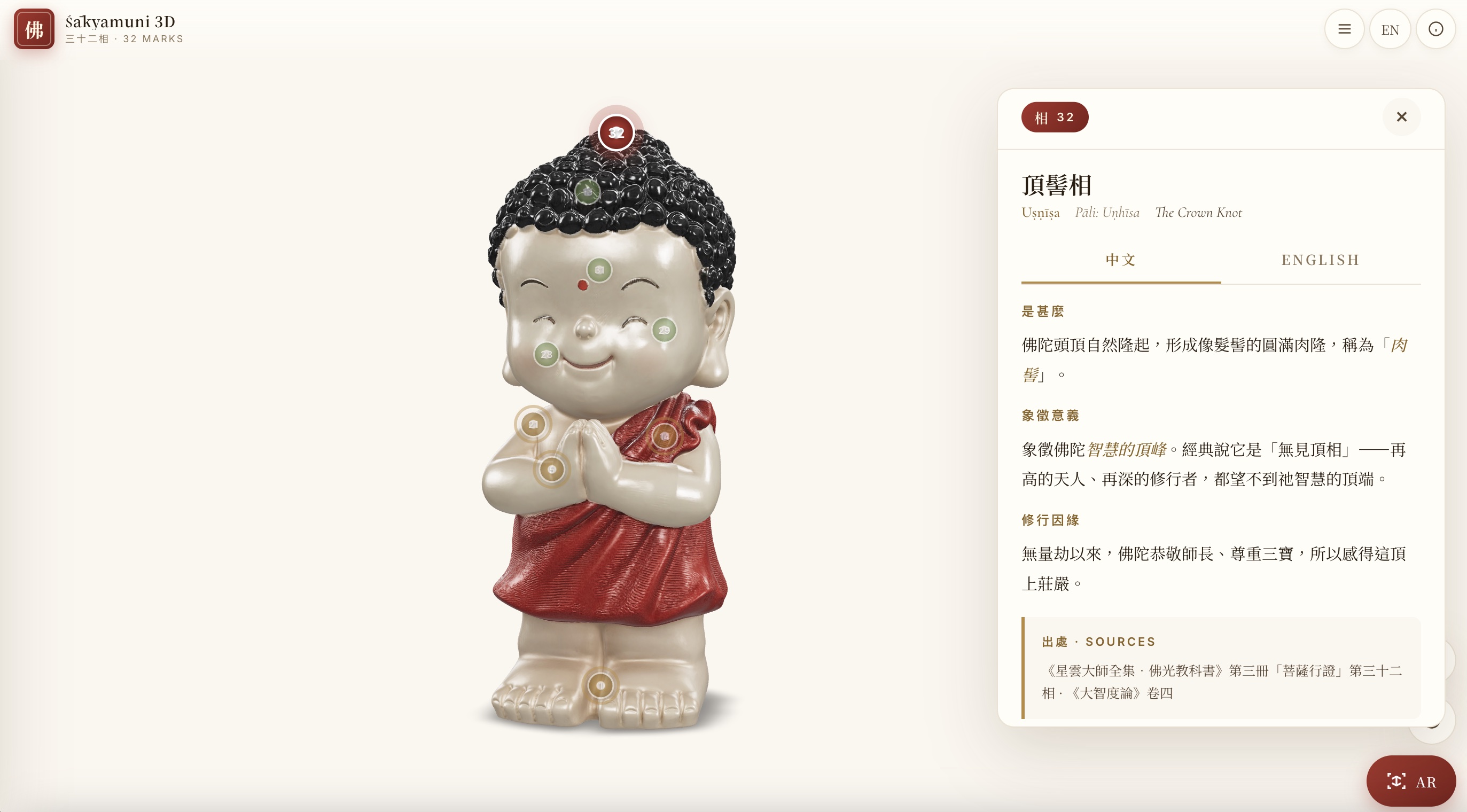
A high-resolution 3D scan of the "Three-Acts Prince Pumǎn" figurine — co-authorised by Hong Kong Fo Guang Shan — that introduces the Buddha's thirty-two distinguishing bodily features. Drag, zoom, tap golden points, or launch AR mode to view the icon in your own space.

  • Browser-native 3D model viewer (no install)
  • 32 interactive hotspots with bilingual annotations
  • Augmented Reality (AR) mode for mobile devices
  • Source citations from canonical sūtras
Launch Tool ↗ See Sources
Digital Buddhist Lexicon NLP / Lexicon
佛學大辭典
Digital Buddhist Lexicon

Digital Buddhist Lexicon

Ding Fubao 丁福保《佛學大辭典》(1922) — Reborn for the Digital Age

A research-grade web platform built on Ding Fubao's monumental Buddhist Dictionary (over 30,000 entries, 3.6 million characters). It transforms a paper-bound classic into a searchable, analysable, and visualisable resource — with semantic networks, frequency analytics, and bilingual cross-reference.

  • Millisecond-level fuzzy search across name and full text
  • D3.js-powered semantic network with multi-depth expansion
  • Inline English glossing via NTI Buddhist Text Reader
  • Visual analytics: frequency, character cloud, citation rank
Launch Tool ↗ Browse Entries

Background


Recent advances in artificial intelligence, 3D scanning, and natural language processing offer unprecedented ways to digitise Buddhist heritage and primary sources — making them accessible, queryable, and analysable beyond the limits of the printed page. Against this backdrop, "Digital Humanistic Buddhism" pioneers the use of state-of-the-art digital technology for the innovative creation, presentation, and dissemination of Buddhist thought. The two tools above are concrete, working demonstrations of this vision.

Initiative Objectives


Three pillars guide our ongoing work

1

Build & Release Digital Tools

Design, develop, and openly release interactive applications across four core domains: (a) technology for Buddhist translation, (b) natural language processing for Buddhist texts, (c) visualisation of Buddhist manuscripts and material culture, and (d) computational approaches to Buddhist studies. Śākyamuni 3D and the Digital Buddhist Lexicon are the first two outputs of this pillar.

2

Promote Public Engagement

Raise awareness — among Buddhists, scholars, and the broader community — of the opportunities, challenges, and ethical considerations of human-computer interaction in dharma transmission, through online talks, an international conference, and continuous outreach.

3

Seed a Larger Ecosystem

Serve as a pilot for substantially larger Digital Buddhism initiatives — providing reusable datasets, open-source code, and methodological precedents for future cross-institutional collaboration.

Knowledge Exchange


Talks and conferences disseminating the initiative's research.

Online talk 1

Online Talk I — Digital Visualization of Buddhist Heritage

Introducing state-of-the-art digital approaches to the preservation of Buddhist monuments, excavated artifacts, and epigraphic manuscripts.

Online talk 2

Online Talk II — Technology for Translating Buddhist Texts

A focus on AI-driven applications that facilitate the translation of Buddhist texts, alongside computational methods for analysing the history of scriptural translation.

International conference

International Conference — Humanistic Buddhism in the Digital Era

"Humanistic Buddhism in the Digital Era: The Way Forward" — gathering scholars from leading institutions to chart the research agenda for the 21st century.

Funding & Acknowledgements


This initiative is generously funded by the Research Matching Grant Scheme (RMGS), University Grants Committee (UGC), Government of the Hong Kong Special Administrative Region, under the project

“Digital Humanistic Buddhism: A New Approach to Contemporary Buddhist Studies”

We gratefully acknowledge our partners — Hong Kong Fo Guang Shan, the Chinese Cultural Foundation, the Dharma Drum Institute of Liberal Arts (DILA), the Chinese Buddhist Electronic Text Association (CBETA), and the NTI Buddhist Text Reader — whose open scholarship makes this work possible.

© 2022–2026 The Centre for Humanistic Buddhism, The Hang Seng University of Hong Kong · Digital Humanistic Buddhism Initiative